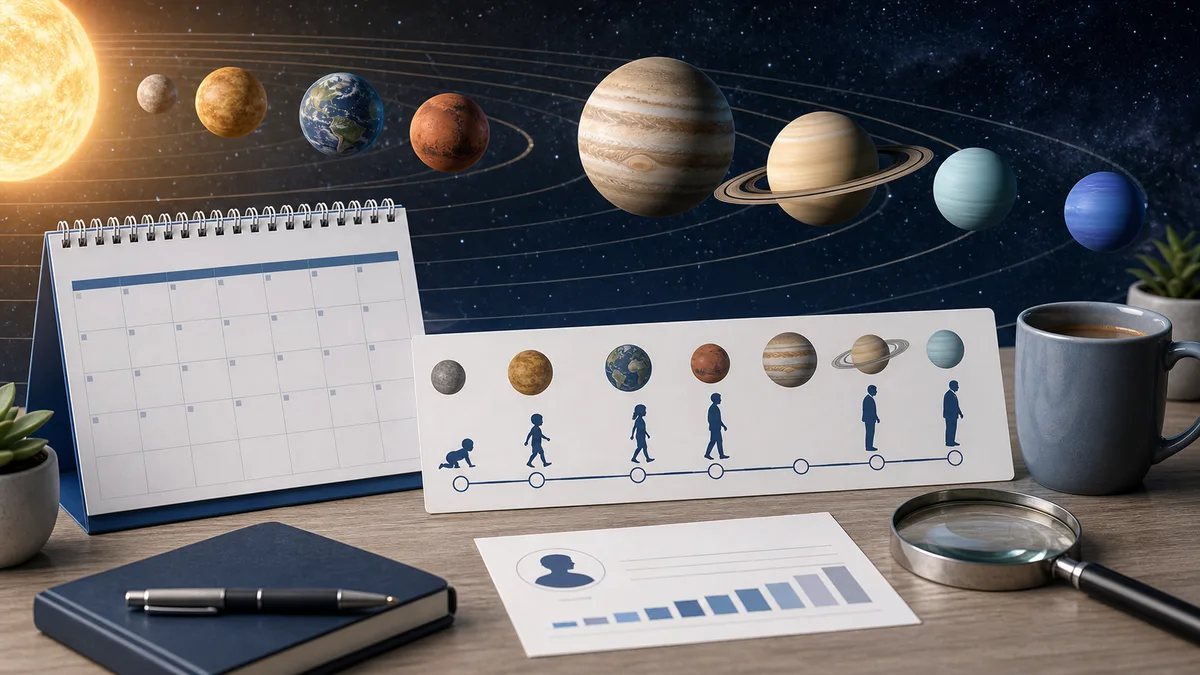
Age on Different Planets Guide, Planet Years and Space Age Explained
Why your age changes on other planets and what planet years mean.
Age Finder editorial team | 8 min read | Updated 2026-07-15
Planet age changes because each planet takes a different amount of time to orbit the Sun.
A planet age result should show your age in planet years and explain the orbital period behind the number.
Planet age is an astronomy-based comparison for learning and fun, not a separate biological age.
A planetary age compares orbital periods
Your age on another planet is a comparison between elapsed Earth time and that planet's orbital period around the Sun. Mercury completes an orbit much faster than Earth, so the numerical Mercury-year age is larger. Neptune takes far longer, so the Neptune-year age is much smaller.
This is an astronomy conversion, not a claim that a human body would age differently after moving to another planet. Biological aging still follows elapsed time. The result answers how many of that planet's years fit into the time lived on Earth.
How planetary age is calculated
First calculate the elapsed time from the date of birth to the selected date. Then divide that duration by the planet's sidereal orbital period, using values from a consistent astronomical source. For an educational result, it is reasonable to show decimal planetary years and the completed number of planetary orbits.
Suppose an Earth age is 20 years. Dividing by Mars's orbital period of about 1.88 Earth years gives roughly 10.6 Mars years. The decimal means the person is partway through the next Martian orbit; it is not a calendar date that a community on Mars officially uses.
Do not confuse a planet year with a planet day
A planet year comes from revolution around the Sun. A planet day comes from rotation, and even “day” can mean a sidereal rotation or a solar day. Venus is a striking example because its rotation is slow and retrograde. Converting age into local days therefore requires a separately defined rotation period.
When a result includes years, days, hours, minutes, or seconds for each planet, the labels must identify the units. Earth seconds are elapsed SI time; “Mercury days” are divisions by Mercury's chosen day length. Those values should not be placed under the same heading as if they were interchangeable.
Use the result for learning, comparison, and curiosity
Orbital periods are not exact whole numbers, and different references may round them differently. A recreational calculator should state or link its source and avoid displaying more decimal places than the source supports. Birth time also matters if the result claims sub-day precision.
Planetary age works well for science lessons, birthday activities, and comparing the scale of the solar system. It does not predict personality, health, longevity, gravity effects, or the experience of living on another world.
Official sources and further reading
These references support the factual and safety context in this guide. Rules and guidance can change, so use the linked authority for current decisions.
Frequently asked questions about Age on Different Planets Guide, Planet Years and Space Age Explained
How old am I on other planets?
Divide your elapsed Earth time by each planet's orbital period to express it in that planet's years.
Why am I older on Mercury?
Mercury orbits the Sun in much less time than Earth, so more Mercury years fit into the same elapsed time.
Why am I younger on Neptune?
Neptune's orbit takes about 165 Earth years, so most people have completed less than one Neptune year.
Is a Mars year the same as a Mars day?
No. A year measures one orbit around the Sun; a day is based on the planet's rotation.
Would I physically age faster on Mercury?
No. The calculator changes the unit used to describe elapsed time, not biological aging.
Why do calculators give slightly different values?
They may use differently rounded orbital periods, reference dates, or decimal precision.
Can planetary age be exact to the second?
Only with a birth time, reference time, defined time scale, and clearly specified planetary unit.
Is planetary age an astrology result?
No. It is an astronomical time-unit comparison based on orbital periods.
Privacy choices
Cookie settings
Age Finder Online uses essential browser storage for theme, consent, and basic site features. Optional analytics help us improve the site, and advertising consent helps support free tools with Google AdSense. If you decline, ads may be limited or less relevant.